The Nature of Successful Exploration
Exploration is one of the most beautiful occupations a person can choose. It carries you to the remote corners of the planet where the map still has gaps and the horizon still has manners. It lets you travel, work with new people, learn new cultures, and spend your days reading the oldest book on Earth, one outcrop at a time.
If you are the sort of person who prefers a ridge line to a boardroom, exploration will gladly accommodate you. Then it teaches you humility.
The Earth does not reward effort. It rewards being right.
You can work hard, spend hard, assemble a team of bright minds, and still be met with silence so complete it feels like a judgement. It is not a judgement. It is simply geology doing what geology has always done.
The ground does not applaud. It does not send apology letters. It does not promise that next season will be kinder. It just sits there, old and unmoved, waiting for you to ask the right question in the right way.
That is why it is worth speaking about successful exploration as something distinct. Exploration can mean disciplined target testing and decisive learning. It can also mean expensive wandering with impressive paperwork.
Successful exploration is narrower and more demanding. Successful exploration is what happens when a team turns uncertainty into learning fast enough to matter, then turns that learning into action that can lead to ore.
Ore, not interesting mineralisation. Ore, not attractive theories. Ore, not a story that sounds good in a presentation and disappears the moment a drill bit arrives.
Now, some people start to fidget when you speak like that, because it sounds as if we are turning science into accounting. We are not. We are putting science in its proper role.
Exploration is a business that uses science. It is not science that hopes to become a business.
Science is how we observe, measure, test, and reduce self-deception. Business is how we decide where to spend the next dollar, how quickly to force a real answer, and when to stop. If you forget the business part, you can keep a prospect “interesting” for years.
Most exploration companies do not fail because they are unintelligent. They fail because decision quality quietly decays. The program becomes gentle. The targets become protected. The story becomes more important than the test. Work multiplies in polite layers, one more survey, one more dataset, one more reinterpretation, all respectable, all defensible, and still no decisive answer. The treasury empties itself quietly, like a leaky jerrycan everyone meant to fix tomorrow.
Successful exploration has a different temperament. It moves toward truth. It creates moments where a project either improves in a meaningful way or is dropped without drama. It is not allergic to bad news. It is allergic to wasted time.
That rhythm is created by people, not by an organisation chart. And this is where organisations are frequently misunderstood. Organisations matter, but not in the way brochures suggest.
A company can provide capital, logistics, safety systems, governance, and a culture. It can provide the climate in which good judgement is encouraged, and poor judgement is corrected before it becomes expensive. That is not nothing. That is valuable.
But an organisation does not stand at an outcrop and notice the awkward fact. It does not wake up at three in the morning, remember a detail everyone ignored, and change the drill plan before breakfast. It does not choose the one hole that can settle the argument.
A person does.
The discovery hole, if it comes, comes from an individual decision made when the information is incomplete and the consequences are complete. Which is precisely why open communication and distinctive strong leadership are not soft ideas in successful exploration. They are part of the technical system.
Open communication is how reality enters the room before it becomes expensive. Exploration is full of partial truths, noisy signals, and seductive patterns that can be explained in different ways. If doubts are not spoken, the team pays for silence.
If awkward facts are treated as inconvenient, they do not vanish. They return later with interest and a grin. A culture that encourages plain talk, especially when the talk is uncomfortable, is not “nice.” It is efficient.
Strong leadership in exploration is not about talking louder than the data. It is about keeping the work aimed at decisive learning instead of comfortable activity. It is about choosing a target, choosing a test, and accepting the result without hiding behind a crowd.
Committees can help with governance and risk oversight, but committees rarely drill the discovery hole. A person does, and that person needs permission to think clearly and act decisively.
Blog Post Image Description for corresponding paragraph.
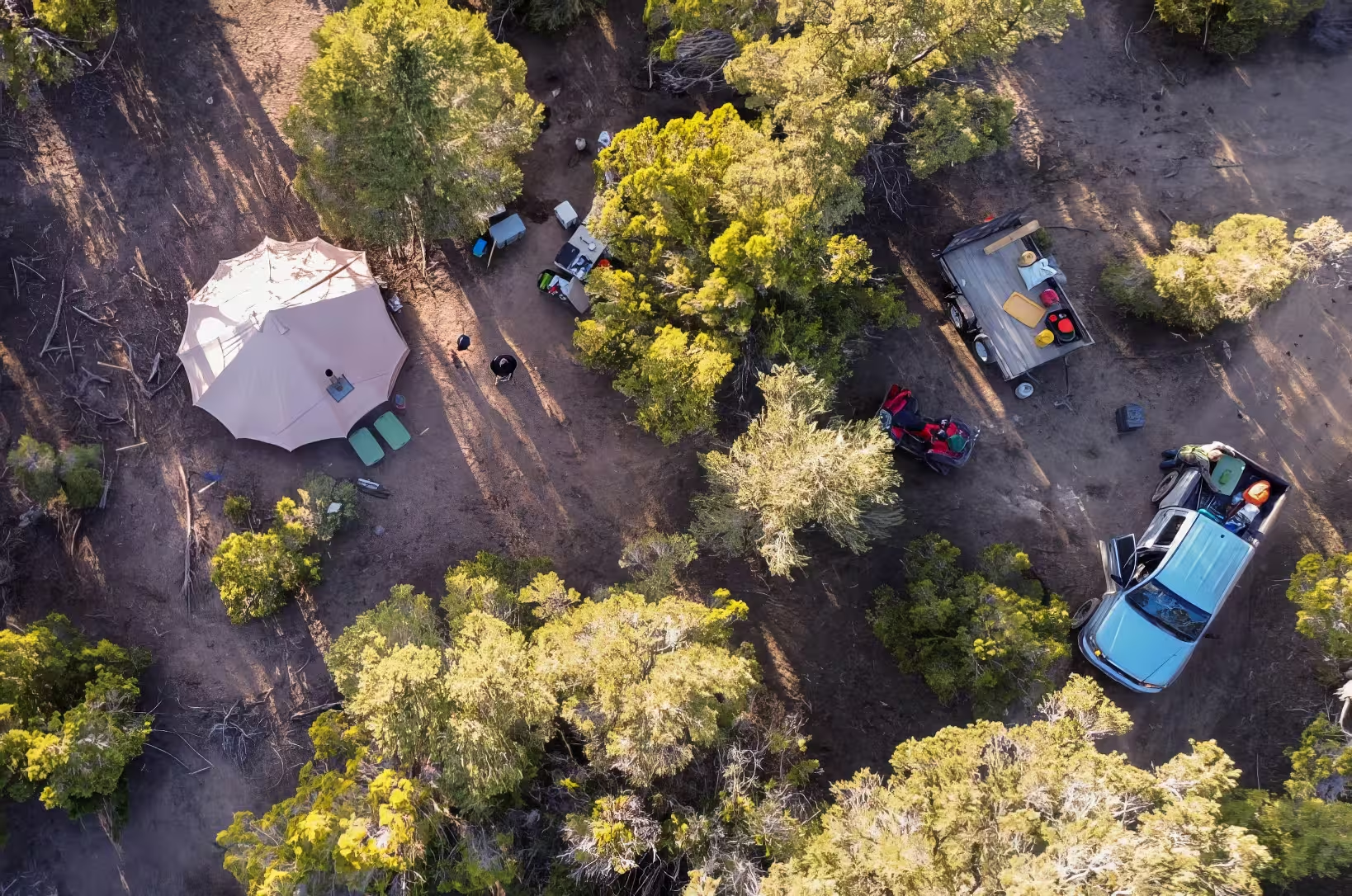
Probability and Capital Discipline
Now we come to probability, which is where exploration stops being romantic and starts being professional.
Each deposit is a statistical phenomenon.
Economic deposits are rare enough that you cannot treat every target as equal. Capital has to be directed where the probability is improving, where the system is supported by evidence, and where a decisive test is affordable. If you cannot explain why the odds are better here than elsewhere, you are not exploring, you are simply spending.
Virgin ground can sound irresistible. It has a clean map, no historical baggage, and the kind of blank space that makes a person feel like history is waiting for their name. But blank space is not free.
Starting from zero means paying for everything from the beginning, building the geological case, building the targets, building access, and often building the entire understanding of the system before you even get to the decisive test.
That is a game majors can sometimes afford to play. Juniors usually cannot, not for long, not without very sharp discipline, and not without early proof that the system you are chasing has a real chance of existing.
The key question is not whether virgin ground is “good” or “bad.” The key question is whether there is enough evidence to justify the cost of learning. If there are no mines, no prospects, no meaningful indications of a mineral system, and no convincing reasons to believe the plumbing is there, then virgin ground becomes an expensive way to buy uncertainty.
In that situation, the professional move is often to avoid it, or to test it quickly and cheaply, and walk away early if it does not begin to earn its keep.
This is not a criticism of frontier exploration. Big deposits can still be found in unexpected places. It is simply an argument for realism. Successful exploration respects probability and it respects price. Orebodies are rare enough that you want evidence on your side, and you want your budget aimed where it can actually reach an answer.
That is why your line belongs in any honest guidance on successful exploration, because it is really about probability and capital discipline, not romance.
The two points make a trend. This should be that you will rather explore where the ore has been found rather in the virgin area. Two points do not guarantee a deposit. They do something more useful early on.
They give direction and context. They tell you the system has already proven it can concentrate metal, which is the hardest trick in the entire show. They let you work with geometry instead of wishful thinking.
Once you have a target, successful exploration demands discipline. The target is not a painting to be admired. It is a hypothesis to be tested. Your job is not to decorate it with more work. Your job is to test it in a way that can settle the matter.
There is a reason drilling makes people nervous. Drilling ends arguments.
A decisive test is the fastest honest action that answers the real question, not the comfortable one. The comfortable question is whether something looks interesting. The real question is whether there is an orebody here, or a plausible path to one.
Drilling is often the act that turns speculation into fact at depth. It does not need to be reckless. It needs to be designed to produce an answer.
This is where many programs quietly go wrong while still looking professional. They run more geophysics because it seems cheaper than drilling, then spend so long interpreting it that drilling becomes unaffordable.
They map and sample for years because it feels thorough, then discover that thoroughness has not produced a single ore grade and width intercept. They call it risk reduction, while spending more money avoiding risk than it would cost to confront it with a properly designed drill test.
This is not an argument against science. It is an argument against using science as an elegant delay.
I have seen companies burn cash on detailed mapping, thousands of samples, and multiple geophysics campaigns, then walk away right before the moment of truth because they feared failure.
That is like buying a theatre ticket, finding your seat, and leaving when the curtain rises because the ending might be sad. If the target has merit, it deserves a definitive test. If it is going to fail, let it fail early enough that you learn, and still have budget to do something smarter next.
Negative results, when they come from a clean test, are not always wasted. A properly placed hole can expose the wrong depth assumption, the wrong structural interpretation, the wrong regolith model, or the wrong source of an anomaly.
In deeply weathered terrains, the surface can mislead with impressive confidence. In the search for blind deposits, the first drilling pass often teaches you what the system is not, which can be the first step toward understanding what it is.
But honesty is the admission ticket. If the hole truly tested the idea and it came up dry, the next step is not to write better adjectives. The next step is either a genuinely new concept with a genuinely new target, or the discipline to walk away while you still have the money to start a better program.
Blog Post Image Description for corresponding paragraph.
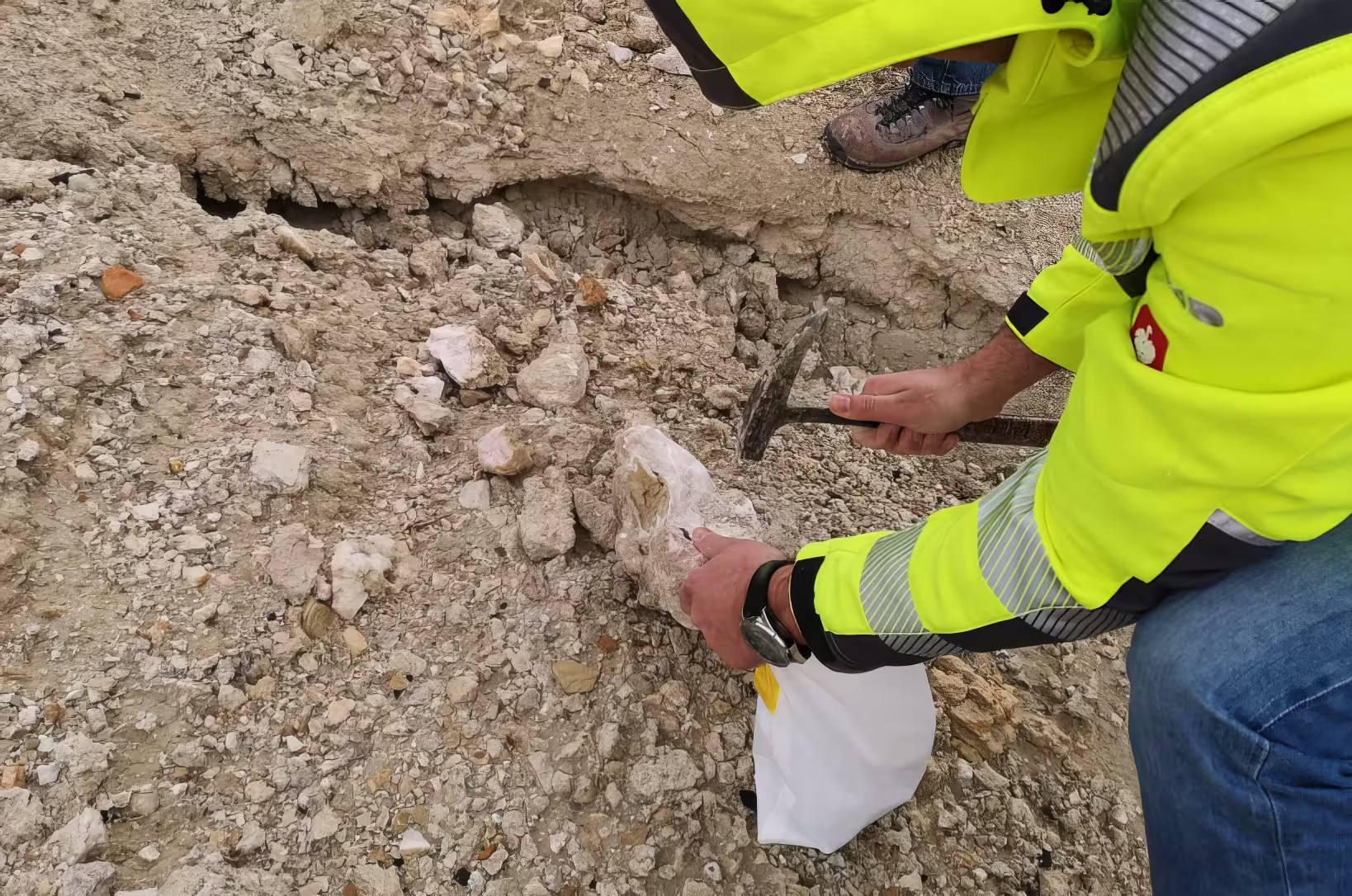
Is There Room?
The lesson that traps more companies than bad luck ever could often arrives wearing good news.
A good intercept is not a deposit. A deposit is not a mine. A mine is not a business unless tonnes and grade live together long enough to pay for everything that follows. Many companies get stuck because they fall in love with nice hits and do not ask the unromantic question early enough.
Is there room?
Room means physical room and geological room. It means the host rocks and structure can plausibly contain an economic concentration at mineable scale. It means continuity that can survive drilling density and still make sense.
It means geometry that does not require miracles to be mined. It means you are not trying to build a world class deposit inside a system that is, by its nature, a narrow corridor with hard boundaries.
We have all watched the story. A company hits something compelling. The market smiles. The team becomes attached. Then the geology starts murmuring the inconvenient truth. The controlling structure is short.
The receptive horizon pinches out. Faults carve mineralisation into small blocks. Alteration looks impressive but the true mineralised width is thin. Grade flashes in one place and vanishes in the next. The evidence keeps pointing to a system that cannot grow into an economically viable deposit.
And yet the program continues, because the first hit looked wonderful in a headline.
That is how money gets trapped. It is the exploration version of trying to turn a small room into a ballroom by pushing the furniture around. You can push forever. The walls remain unimpressed.
The scale question is not pessimism. It is capital discipline. It forces you to step out and test size, not merely confirm presence. It forces you to cover the target in the only way that matters, by bounding the geometry that controls volume.
You are not drilling to prove mineralisation exists. You are drilling to test whether mineralisation can assemble itself into ore at scale.
Blog Post Image Description for corresponding paragraph.
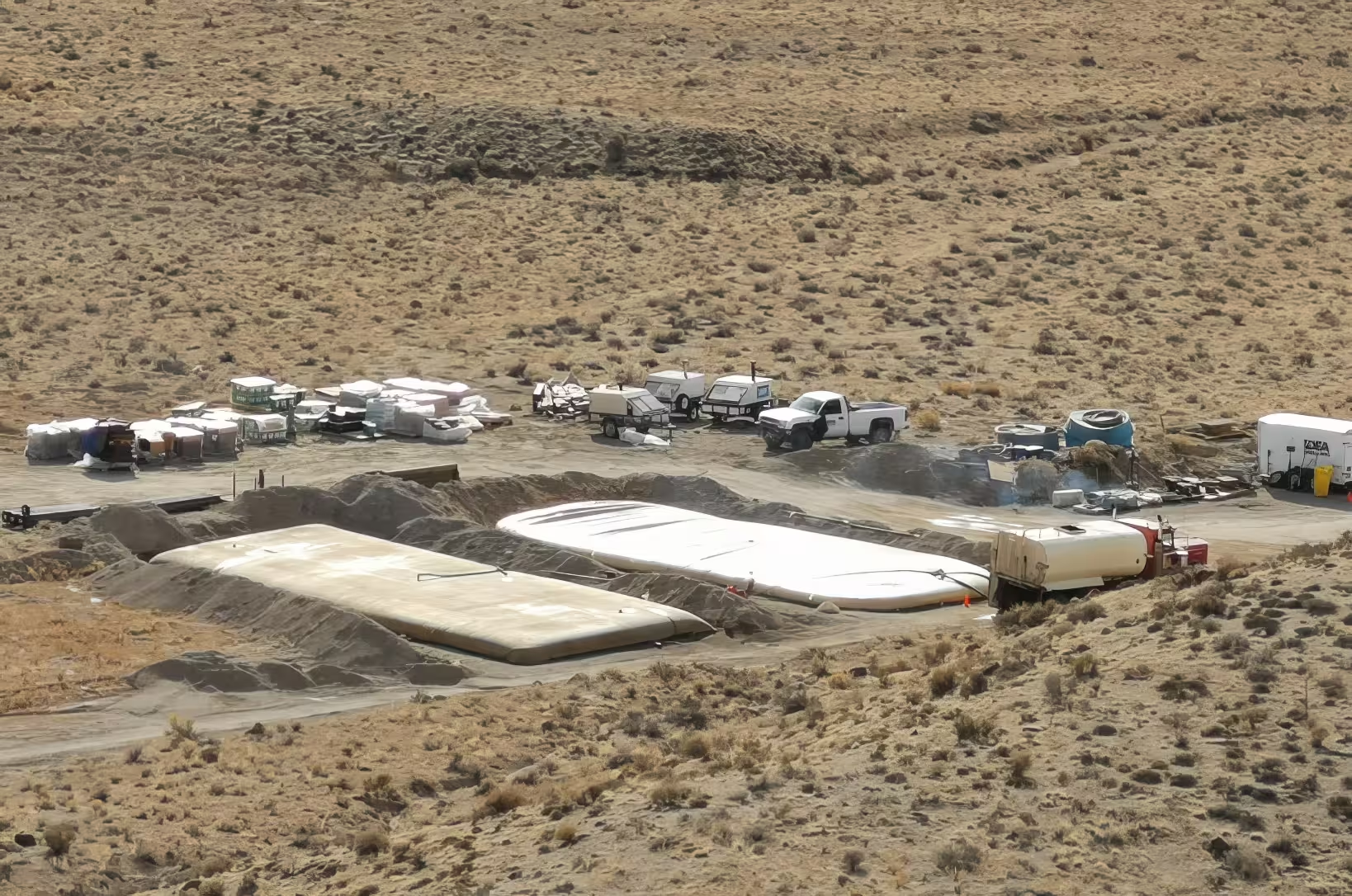
Ore, Not Mineralisation
The central filter that defines successful exploration is simple: Look for ore, not mineralisation.
Mineralisation is common. It can be alteration, showings, sulphides, geochemical halos, and beautiful rocks that make geologists happy and investors briefly poetic. Ore is rare. Ore is what survives economic interrogation, continuity, metallurgy, and mining reality. Ore is what remains after the questions stop being romantic and become financial.
Now, it would be a mistake to end this guidance as a scolding, because successful exploration is not a grim profession. It is demanding and uncertain, yes. It is also worth doing.
It is worth doing because it rewards curiosity and courage. It teaches humility. It takes you into wild places and brings you home with better judgement than you left with. A real discovery does not merely change a spreadsheet. It can change a company, a district, and sometimes a region’s future.
But the privilege comes with responsibility. There must be an outcome for the invested effort. There must be a path to ore.
So enjoy the trip. Enjoy the cultures. Enjoy the sunrise on a ridge you earned with sore legs and bad coffee. Just do not confuse the beauty of the work with the purpose of the work.
The purpose is ore.
FrontFinders helps clients build successful exploration programs with clear thinking, open communication, distinctive strong leadership, and decisive tests that turn uncertainty into an answer. That answer is sometimes yes. Often it is not. Either way, it is progress.